
October 7, 2026
How to Build Meta Audiences That Generate Leads
By Dylan Nelson, founder of Spry Growth
Learn how to build Meta audiences that bring in qualified leads, from customer lists and local targeting to retargeting and testing that improves results.
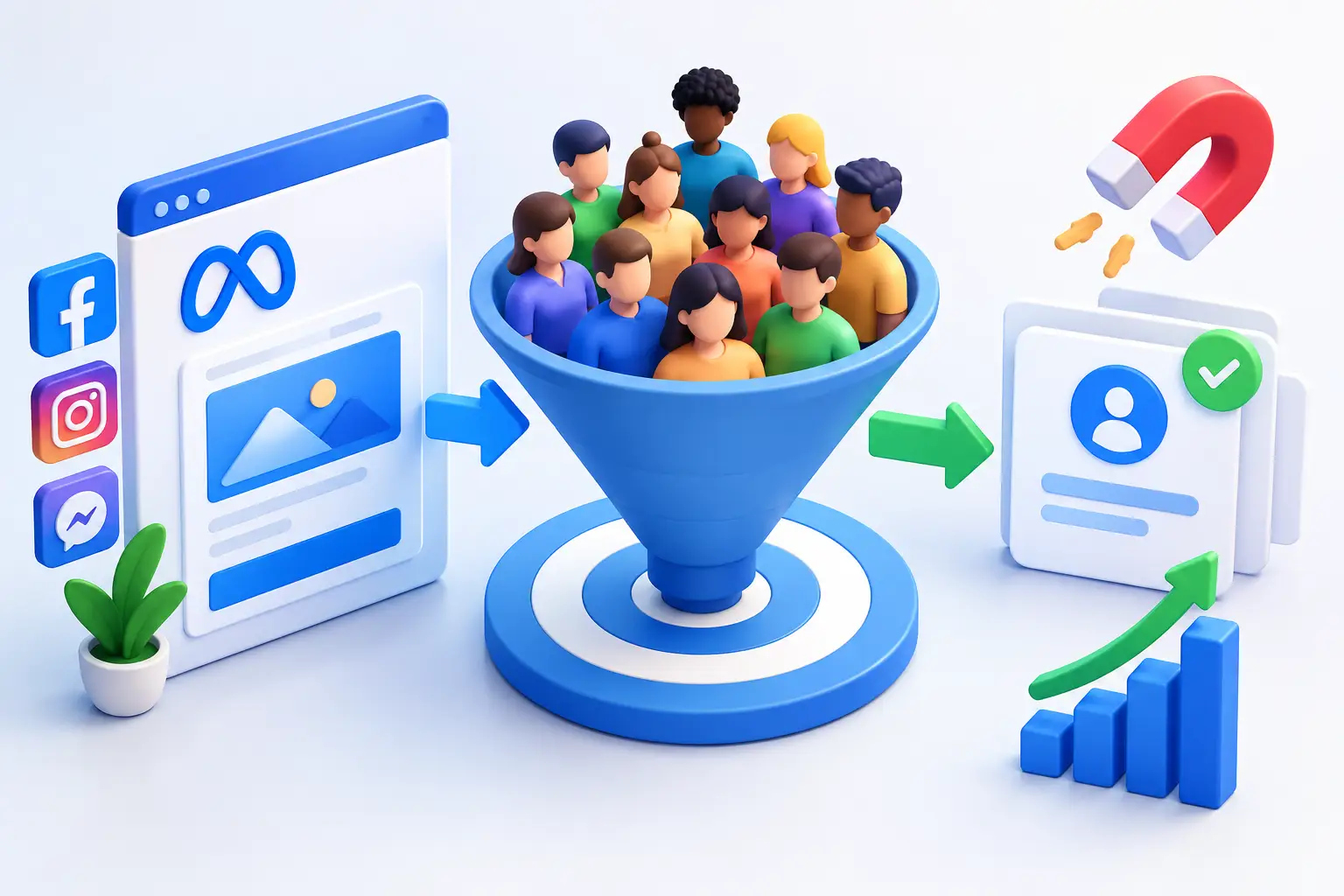
A Destin contractor can get plenty of form fills from Meta Ads and still have a slow month. The issue is often not the ad itself. It is who sees it, what they are asked to do next, and whether the business can tell a real prospect from someone casually browsing. Learning how to build Meta audiences is about creating a system that puts ads in front of people with a credible reason to become customers.
Meta gives advertisers a huge amount of targeting flexibility, but more targeting is not automatically better. Small and mid-sized businesses usually get stronger results from a clear audience structure, reliable conversion tracking, useful creative, and disciplined testing than from stacking dozens of interests into one ad set.
Start with the conversion, not the audience
Before building an audience, define the action that matters to the business. For a dentist, it may be a completed new-patient request or a booked consultation. For a home services company, it could be a qualified phone call or estimate request. A 30A vacation rental manager may care more about an inquiry that includes travel dates than a generic website visit.
This sounds basic, but it changes the entire campaign. If Meta is optimized for cheap leads, it will look for people likely to submit a form. That does not mean those people are likely to answer the phone, meet your service requirements, or buy.
Set up tracking for the actions closest to revenue that you can reliably measure. At minimum, know when a prospect submits a form, calls from an ad or landing page, and reaches a booking confirmation page. When possible, feed qualified-lead or booked-job outcomes back into the system. Better inputs give Meta a better chance of finding people who look like customers rather than just clickers.
The four audience groups every account needs
A practical Meta account usually has four distinct audience groups. They should not all be launched at once or given equal budget forever. Their roles are different.
- Warm audiences include people who have visited key website pages, engaged with your Instagram or Facebook content, watched videos, opened lead forms, or messaged the business.
- Customer audiences are built from existing customer, lead, inquiry, or subscriber lists that can be securely uploaded and matched within Meta.
- Lookalike audiences use a customer or high-quality lead source to find new people with similar characteristics.
- Broad prospecting audiences use limited targeting constraints and let Meta's delivery system identify likely converters within your location and age parameters.
The right mix depends on budget, buying cycle, and how much usable data the business has. A newer company may begin with broad prospecting and simple retargeting. A practice with years of patient inquiries or a contractor with a well-maintained CRM can build stronger customer-source and lookalike campaigns from the start.
Build warm audiences around buying intent
Retargeting is often treated as one audience: everyone who visited the website in the last 180 days. That approach is easy, but it mixes serious prospects with accidental clicks and people who landed on a blog post months ago.
Segment visitors by intent where traffic volume allows it. Someone who viewed a service page, pricing information, contact page, booking page, or financing page is generally more valuable than someone who spent five seconds on the homepage. A user who started a form but did not submit it deserves different messaging than a person who watched a brand video.
For example, a Fort Walton Beach HVAC company could retarget recent visitors to its AC repair page with a direct message about scheduling service. A separate audience of past maintenance-plan customers may be better served with a seasonal tune-up reminder. Those are different conversations, even if both groups live in the same service area.
Keep retargeting windows tied to the sales cycle. Emergency plumbing leads may need a seven- to 14-day window because the decision happens quickly. Cosmetic dental or real estate audiences may justify longer windows because people research over weeks or months. Longer is not automatically better. As time passes, the prospect's intent usually declines.
Use customer data carefully and intelligently
Customer lists are valuable because they represent real business outcomes, not platform assumptions. But the quality of the list matters more than its size.
A list of completed jobs, booked appointments, repeat purchasers, or qualified consultations is usually more useful than every lead the business has ever collected. If a lead source brought in many low-value inquiries, using it as a lookalike seed can teach Meta to find more of the same.
Separate lists when the customer types are materially different. A remodeling company might have one audience based on kitchen renovation clients and another based on small repair jobs. If the goal is to generate larger renovation projects, use the higher-value project list as the source. A restaurant promoting private events should not necessarily model its audience on every person who ordered takeout.
Always exclude existing customers from acquisition campaigns when the offer is meant for new business. Otherwise, you can waste spend advertising a first-time special to people who already buy from you. There are exceptions, such as cross-selling a new service or promoting a loyalty event, but exclusions should be intentional.
How to build Meta audiences for local businesses
Location settings do heavy lifting for local campaigns. Start with the actual service area, not a vague radius just because it creates a larger audience. A Niceville electrician may serve nearby communities but not want calls from customers across the bridge or well outside its profitable travel zone.
For destination-driven businesses, seasonality complicates the picture. A restaurant, attraction, or rental-related business on the Emerald Coast may need separate thinking for visitors and locals. During peak visitor months, geographic targeting around the destination plus timely creative may be more useful than an overly narrow interest audience. In slower periods, campaigns can shift toward local residents, repeat visitors, events, gift cards, or services that are less dependent on tourism.
Avoid making location targeting so tight that delivery becomes unstable. Meta needs enough potential reach to learn. If a niche business serves a small area, broaden the geography modestly before piling on more interests. The goal is not to reach everyone. It is to give the platform enough qualified opportunity to find converters.
Do not overbuild interest targeting
Interest targeting can still be useful, especially when you are launching without much conversion data. The mistake is assuming every relevant interest improves quality.
A roofing company might target homeowners, home improvement, and related topics. But adding ten more interests can shrink the audience, raise costs, and make it difficult to know what actually worked. Interest categories are also imperfect. A person interested in home renovation content may be a renter, a DIY hobbyist, or someone who will never hire a contractor.
Use interests as a testable hypothesis, not as a permanent truth. Compare a focused interest audience with a broader audience under the same offer and creative conditions. If broad targeting produces qualified leads at a better cost, keep it. If a specific audience consistently generates booked estimates, scale it carefully.
Match the message to the audience stage
Audience building and ad creative are connected. A warm prospect does not need the same introduction as a cold prospect.
Cold audiences need a fast explanation of the problem you solve, who you serve, and why taking the next step is worth it. A strong offer can help, but it should not attract people who only want a discount and have no intent to buy. For a local service business, clear service-area coverage, response expectations, and proof of the process can filter out poor-fit leads.
Warm audiences can be more specific. Address common concerns, show before-and-after work where appropriate, explain what happens after someone requests an estimate, or answer a question that keeps people from booking. Customer audiences may respond best to a relevant next service, seasonal reminder, or referral message.
If the ad promises a free estimate, the landing page should immediately make it easy to request one. If it promotes online booking, the booking experience needs to work well on a phone. Audience quality cannot compensate for a slow page, unclear form, or missed calls.
Test for booked business, not cheap clicks
The best way to improve an audience is to judge it by downstream results. Track cost per lead, but also track lead-to-contact rate, qualified-lead rate, booked appointments, show rate, and revenue or pipeline value where available. A $25 lead that books regularly is more valuable than a $10 lead that never picks up the phone.
Test one meaningful variable at a time. Compare broad prospecting against a lookalike, or compare a recent-service-page retargeting audience against an all-website-visitors audience. Give each test enough budget and time to produce usable data. Small accounts can become impossible to manage when every campaign has five audiences, six ads, and no meaningful spend behind any of them.
Watch frequency in warm campaigns. If the same small audience sees the same ad repeatedly, performance can flatten and prospects can become less responsive. Refresh creative, adjust windows, or reduce spend instead of forcing more impressions from a limited pool.
A Meta audience is not a set-it-and-forget-it targeting choice. It is a working part of the customer acquisition system. When tracking reflects real outcomes, ads match intent, landing pages make action easy, and the sales team follows up quickly, audience data becomes more useful with every campaign. That is how paid social stops being a source of random leads and starts contributing to a measurable pipeline.