
August 26, 2026
Marketing Attribution for Service Businesses
Learn how marketing attribution for service businesses connects ads, calls, forms, and closed revenue so you can invest in channels that drive growth.
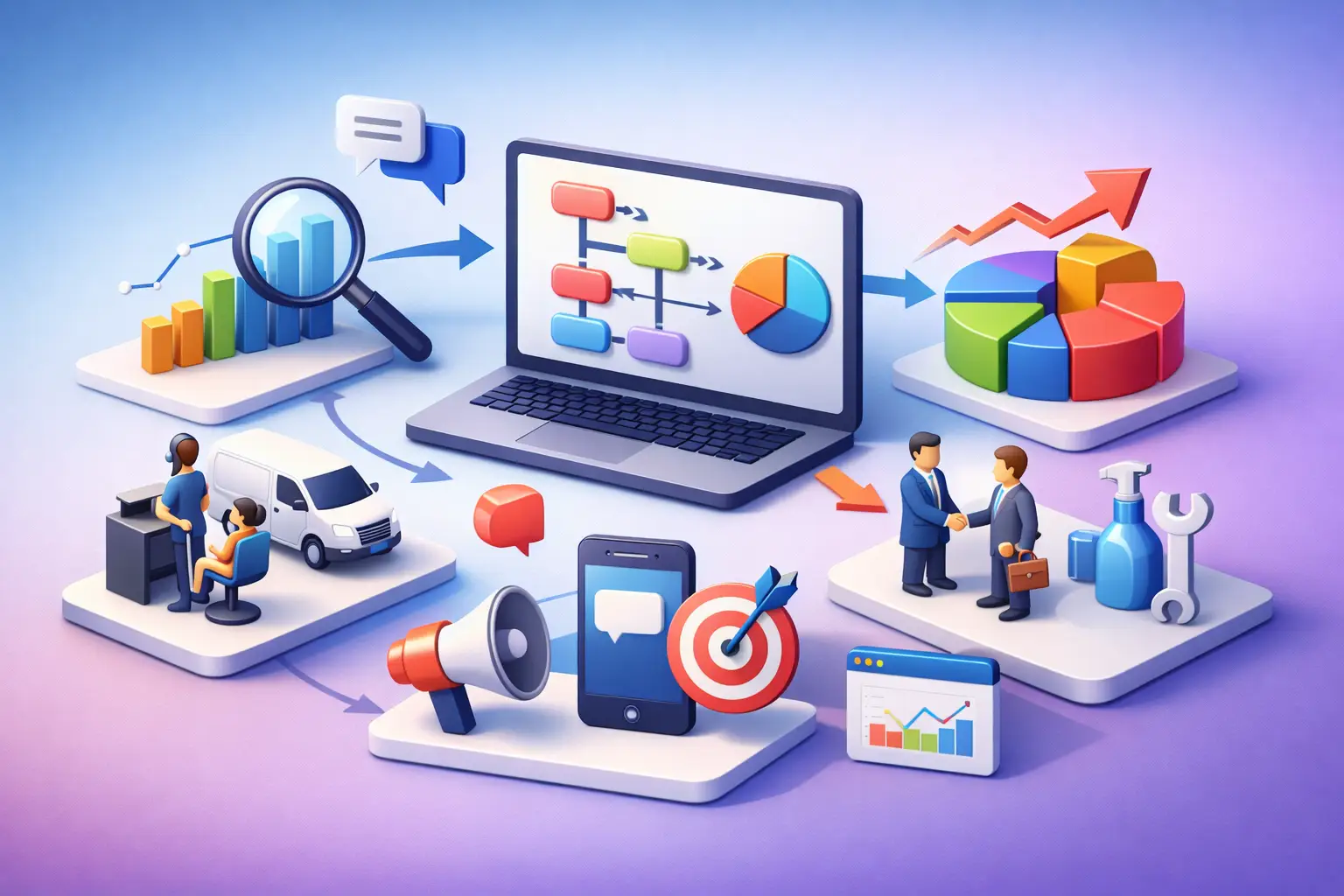
A homeowner searches Google for an HVAC repair company, clicks an ad, leaves without calling, sees a Facebook ad two days later, then searches the company name and books through the website. Which channel gets credit for the job? If your answer is simply “Google” or “Facebook,” you may be making budget decisions with half the story. That is the practical challenge of marketing attribution for service businesses.
For a service company, a lead is not automatically revenue. Calls get missed. Form submissions turn into estimates. Estimates sit in a sales pipeline. Some deals close weeks later, while others never become customers. Good attribution connects those stages so you can see what is producing profitable work, not just inexpensive clicks or leads.
What Attribution Actually Means for a Service Business
Marketing attribution is the process of identifying which marketing touchpoints contributed to a lead, appointment, sale, or closed job. Those touchpoints can include Google Ads, Meta Ads, organic search, local SEO, email, referrals, direct traffic, landing pages, and phone calls.
The key word is contributed. Most customers do not follow a neat, one-channel path. A prospective dentist patient may first find a practice through Google Maps, review the website later, click a remarketing ad, and finally call after seeing a branded search ad. A roofing customer may receive a referral from a neighbor but still use Google to compare reviews and request an estimate.
If you only measure the final click before a form submission, you will often overvalue the channel that closes the loop and undervalue the channel that introduced or persuaded the customer. If you give every channel equal credit, you can blur the difference between a channel that creates demand and one that only assists it. The right approach depends on your sales cycle, marketing mix, and how reliably your team records lead outcomes.
Why Lead Counts Are Not Enough
A dashboard can show 60 leads from Google Ads and 80 leads from Facebook. That is useful, but it is not the decision-making finish line.
A $25 Facebook lead may look better than a $90 Google lead until you learn that the Facebook campaign produced mostly price shoppers while Google generated urgent, high-intent calls. If five Google leads become $4,000 jobs and only one Facebook lead becomes a small service call, cost per lead tells the wrong story.
Service businesses need attribution that follows the customer through four points:
- The source that brought in the inquiry.
- The action taken, such as a call, form, booking, chat, or quote request.
- The sales outcome, including contacted, qualified, scheduled, quoted, won, or lost.
- The revenue and, where possible, gross profit tied to the closed customer.
This is how you move from “our ads got leads” to “this campaign created qualified opportunities and closed revenue at an acceptable acquisition cost.” We are accountable to pipeline and revenue, not impressions.
Start With Clean Conversion Tracking
Attribution cannot fix missing or unreliable data. Before debating models, make sure the basic tracking is working.
Your website should record the actions that matter: submitted forms, booked appointments, click-to-call actions, phone calls from tracked numbers, and purchases or deposits when applicable. Google Ads and Meta Ads should receive the conversions that their platforms need to optimize campaigns. Analytics should show where visitors came from and what they did on the site.
That sounds straightforward, but details matter. A contact form thank-you page can be counted multiple times if someone refreshes it. A call tracking number can hide the original source if it is not configured correctly. A booking widget may live on another domain and break the visitor journey unless cross-domain tracking is in place.
For businesses spending meaningful money on paid media, server-side tracking can also improve data quality. Browser-based tracking is limited by consent choices, ad blockers, and privacy controls. Server-side setups do not create perfect visibility or bypass privacy requirements, but they can help platforms receive more reliable conversion signals when implemented properly.
The goal is not to track every tiny interaction. Track the actions that indicate commercial intent, then verify that those actions are legitimate.
Treat Calls Like High-Value Conversions
For many local businesses, phone calls are the revenue engine. Yet calls are often the least understood part of the marketing funnel.
Call tracking can show whether a call originated from paid search, organic search, a Google Business Profile visit, or another campaign. Call recordings and call outcomes, handled responsibly and with appropriate notice, can help a business separate real prospects from spam, vendors, wrong numbers, and existing customers.
A 90-second call from someone asking for same-week service is not equivalent to a three-second misdial. If both are counted as conversions, your ad platform will optimize toward volume instead of value. Qualifying calls by duration, outcome, and eventual booking creates a much better signal.
Connect Marketing Data to Your Sales Pipeline
This is where many attribution efforts stop too early. Ad platforms can report a form submission or call, but they do not automatically know whether that lead became a customer.
Your CRM, field service platform, scheduling tool, or sales spreadsheet needs a consistent way to capture lead source and status. At a minimum, your team should be able to answer: Was the lead contacted? Was it qualified? Did it book or receive an estimate? Did it close? What was the revenue?
Consistency matters more than complexity at first. If one staff member labels a lead “Google,” another enters “website,” and a third leaves the source blank, reporting becomes unreliable. Create simple source definitions and use them every time.
For example, “Google Ads” should be separate from “Google Organic” and “Google Business Profile.” “Facebook Ads” should be separate from an unpaid Facebook message. “Referral” should stay separate from a customer who searched your name after receiving a referral. Those distinctions reveal where your acquisition system is actually working.
Once closed revenue is recorded, qualified offline conversions can be sent back to advertising platforms. This helps Google Ads and Meta Ads learn which leads are more likely to turn into customers, rather than optimizing solely for the easiest form fills.
Choose an Attribution Model That Fits Reality
There is no single attribution model that works for every service business.
Last-click attribution gives all credit to the final channel before conversion. It is simple and useful for understanding immediate demand capture, especially for urgent services such as plumbing repairs or towing. Its weakness is that it can minimize the role of earlier awareness and consideration campaigns.
First-click attribution gives credit to the channel that introduced the prospect. This can be helpful when evaluating awareness efforts, but it can overstate the value of an initial visit that never would have converted without follow-up.
Multi-touch attribution spreads credit across multiple interactions. It makes more sense for higher-consideration services, such as elective dental treatment, remodeling, commercial services, or real estate. The trade-off is complexity. Small businesses do not need a complicated model that nobody trusts or uses.
A practical starting point is to use two views at once: last meaningful conversion source and assisted source. Review both alongside closed revenue. If Google Ads drives most final conversions while Meta remarketing regularly appears earlier in successful journeys, cutting Meta because it has fewer last-click leads could be a mistake.
Use Attribution to Make Better Budget Decisions
Attribution should change what you do, not just make reports look more sophisticated.
If branded Google searches close at a high rate, protect that demand while checking whether other channels are creating it. If a non-branded search campaign produces fewer leads but more booked jobs, it may deserve a larger share of budget than a campaign with cheap, low-quality forms. If local SEO drives calls with strong close rates, invest in the pages, reviews, technical website health, and Google Business Profile work that supports it.
Also look for bottlenecks beyond marketing. A campaign can generate qualified leads and still look unprofitable if calls go unanswered, response times are slow, or estimates are not followed up. Attribution brings those operational gaps into view. That is a feature, not a failure of the marketing.
At Spry Growth, the goal is to build the full customer acquisition machine: qualified traffic, a website or landing page that converts, accurate tracking, and reporting tied to real business outcomes. Ads are only one part of that system.
Build a Reporting Rhythm Your Team Will Use
Review channel performance monthly, with a deeper quarterly look at closed revenue and customer quality. Weekly checks are useful for campaign pacing, tracking errors, and obvious lead-quality issues, but service sales cycles often require more time before results settle.
Keep the report focused on decisions. Track spend, leads, qualified leads, booked appointments or estimates, close rate, revenue, cost per qualified lead, and cost to acquire a customer. A restaurant may care most about reservations and repeat visits. A contractor may care about estimate volume, job value, and sales pipeline. A professional service firm may need to measure consultation quality and signed engagements.
The best attribution setup is not the one with the most charts. It is the one that gives you enough confidence to invest more in what produces customers, fix what leaks revenue, and stop funding activity that only looks busy.