
September 10, 2026
Best Small Business Marketing Channels for Leads
Find the best small business marketing channels for qualified leads, plus how to choose, track, and improve the mix that fits your growth goals today.
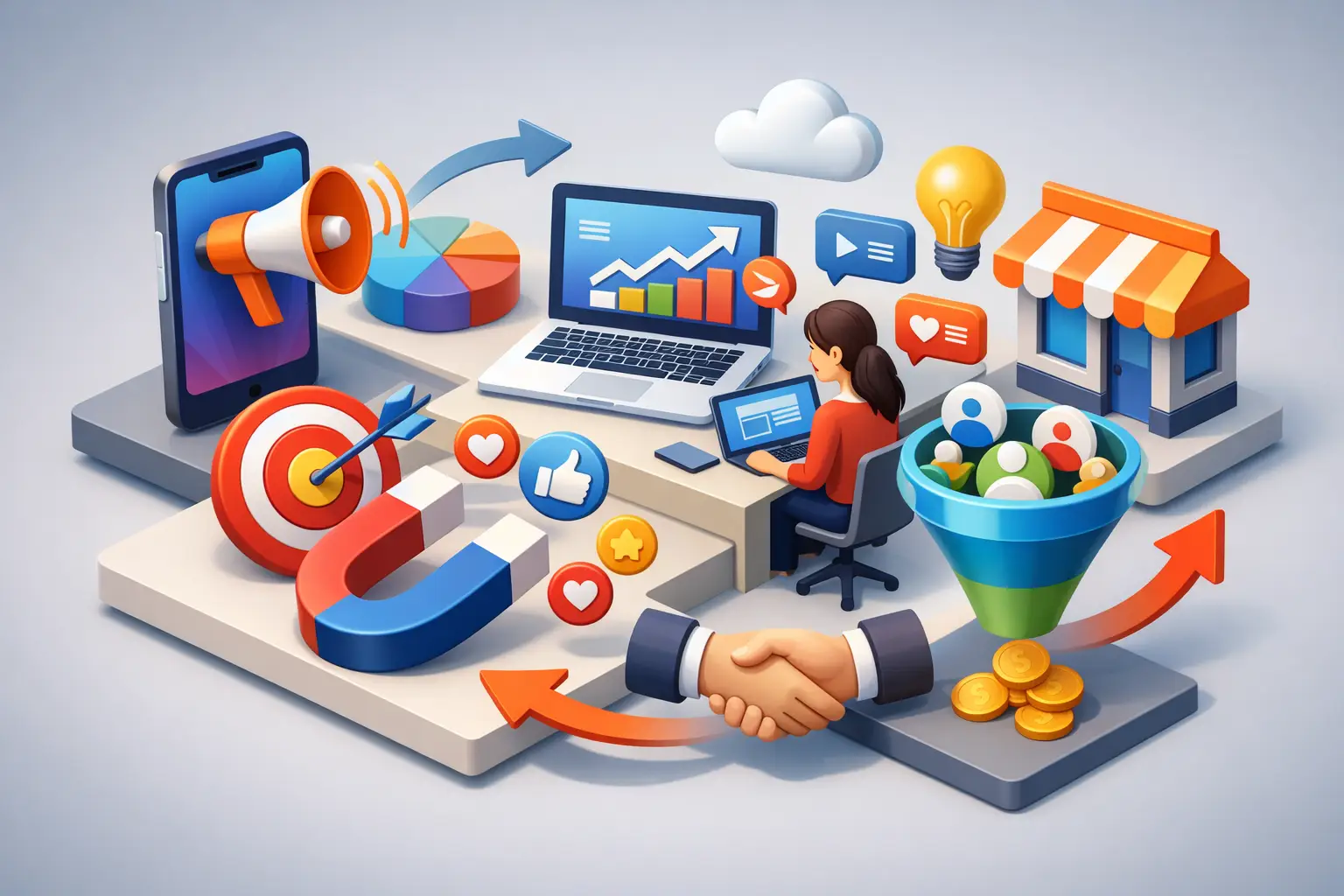
A contractor can spend months posting on social media and get very little from it. That same contractor may turn on a tightly built Google Ads campaign and receive calls within days. Meanwhile, a new restaurant may need social content and local search visibility long before paid search becomes profitable. The best small business marketing channels are not the channels with the biggest audience. They are the ones that put your business in front of the right buyer, at the right moment, and give you a measurable path to a sale.
The mistake is treating every channel as a separate marketing task. Your website, ads, Google Business Profile, landing pages, follow-up, and tracking should work as one customer acquisition system. If the system cannot show which activity produced calls, form submissions, booked appointments, or revenue, it is hard to make a smart decision about where to invest next.
The Best Small Business Marketing Channels Depend on Demand
Before choosing a channel, look at how customers buy from you. A homeowner with a broken air conditioner is actively searching. A person considering cosmetic dentistry may need repeated exposure, proof, and a reason to book. A vacation activity business may have a short booking window driven by location and season.
That buying behavior determines whether you should prioritize intent-based channels, awareness channels, or both. In practical terms, most small businesses should start with channels closest to revenue and expand once the basics are working.
Google Search Ads: Best for high-intent leads
Google Ads is often the fastest paid channel for service businesses because it reaches people already looking for an answer. Searches such as “emergency plumber near me,” “roof repair estimate,” or “family dentist in Destin” signal a need that exists now.
The trade-off is cost and competition. A click is not a lead, and a lead is not necessarily a customer. If the ad sends traffic to a slow, vague website with no clear call to action, the budget disappears without building pipeline. Strong campaigns use tightly matched keywords, location targeting, useful ad copy, negative keywords, dedicated landing pages, and call tracking.
Google Ads makes the most sense when one new customer has enough value to support the cost of acquiring them. It is especially effective for home services, professional services, healthcare practices, and other businesses solving urgent or well-defined problems.
Local SEO and Your Google Business Profile: Best for compounding local demand
Local SEO earns visibility in map results and organic searches over time. For businesses serving a defined area, it is one of the most valuable long-term channels because customers routinely search for nearby providers before they call, visit, or book.
Start with the fundamentals: accurate business details, the right service categories, current hours, useful photos, service-area information, and a website that clearly explains what you do and where you do it. Consistent, legitimate customer reviews matter because they help prospects make a decision once they find you.
SEO is not as immediate as paid search. It takes time to build relevance and trust, particularly in competitive areas such as Destin, 30A, and Panama City Beach. But it can reduce dependence on paid traffic as your visibility grows. The best approach is often to run paid search for immediate demand while building local SEO as the asset that keeps producing later.
Meta Ads: Best for creating and recapturing demand
Facebook and Instagram ads are not usually the first choice for an emergency service call. They are powerful when people need to see the offer before they decide to act. A fitness studio promoting a trial, a med spa introducing a seasonal service, a restaurant promoting private events, or a real estate team staying visible to a local audience can all use Meta effectively.
The creative does much of the work. A polished image alone is rarely enough. Ads need a clear offer, a real customer benefit, and a destination built for the next step. For some businesses, a lead form works. For others, a landing page with availability, FAQs, proof, and an easy way to call or schedule produces better-quality inquiries.
Meta is also a valuable remarketing channel. Someone who visited your service page, watched a video, or started a form is warmer than a cold audience. Reaching that person again can improve conversion rates without paying to find them from scratch.
A High-Converting Website: The channel behind every other channel
Your website is not just an online brochure. It is where paid traffic, organic visitors, referrals, and social audiences decide whether to contact you. That makes it one of the best small business marketing channels in practice, even though it does not create traffic on its own.
A conversion-focused site answers the questions people ask before they reach out: What do you offer? Who is it for? Where do you serve? Why should they trust you? What happens after they call or submit a form? It should also make the next step obvious, whether that is requesting an estimate, booking an appointment, checking availability, or calling now.
Small changes can have a major impact here. Faster pages, mobile-friendly forms, stronger headlines, visible phone numbers, clear service pages, and relevant proof can improve the value of every dollar spent on ads. Increasing conversion rate from 3% to 5% does not sound dramatic, but it can produce substantially more leads from the same traffic.
Email and SMS: Best for follow-up and repeat business
Many businesses focus heavily on generating leads and underinvest in following up with them. That leaves revenue on the table. Email and SMS are effective because they let you continue the conversation with people who already know your business.
For a service company, that might mean estimate follow-up and maintenance reminders. For a dental practice, it could be appointment reminders and recall campaigns. For hospitality and local entertainment, it may be pre-arrival information, special offers, or a reason to come back next season.
Use these channels with care. Messages should be timely, useful, and permission-based. The goal is not to send more messages. It is to reduce missed opportunities and stay relevant between purchases.
How to Choose Your Marketing Mix
A better question than “Which channel is best?” is “What is the next bottleneck in our customer acquisition process?” If you have demand but not enough visibility, invest in Google Ads or local SEO. If you have traffic but few inquiries, improve your landing pages and offer. If you have leads but poor close rates, tighten response time and sales follow-up before increasing ad spend.
Most growth plans should balance one channel that captures existing demand with one channel that builds future demand. For example, a local contractor may pair Google Search Ads with local SEO. A cosmetic practice may combine search ads for appointment-ready prospects with Meta Ads and remarketing to build familiarity. There is no universal mix, but there should always be a clear reason for each channel to exist.
Budget matters too. Spreading a modest budget across five platforms usually creates five weak tests. It is often smarter to focus on one or two channels, collect clean data, improve the conversion path, and expand after you have a repeatable result.
Measure Customers, Not Activity
Impressions, clicks, followers, and video views can be useful diagnostic metrics. They are not the scorecard. The metrics that matter most are connected to business outcomes:
- Cost per qualified lead, not simply cost per form submission
- Lead-to-booked or lead-to-sale rate
- Cost to acquire a customer
- Revenue or pipeline value generated by each channel
That requires proper conversion tracking. Calls, forms, online bookings, purchases, and qualified leads should be captured wherever possible. A business that sees only clicks cannot confidently tell whether an ad campaign is working. A business that can connect marketing spend to booked jobs and revenue can make better decisions quickly.
At Spry Growth, that is the standard: build the machine that produces customers, then measure where it is working and where it is leaking. Sometimes the answer is more traffic. Just as often, the answer is a better page, clearer offer, faster lead response, or stronger follow-up.
Build the Next Channel on a Working Foundation
The most effective marketing channel is rarely a single channel. It is a connected path from attention to action: a customer finds you, understands the offer, trusts the business, takes the next step, and receives a timely response.
Start with the channel closest to your current sales opportunity. Make sure your website can convert the traffic it receives. Track the outcomes that affect revenue. Then add the next channel only when you know what success looks like. That approach may feel less flashy than being everywhere at once, but it is how small businesses build dependable lead flow instead of chasing marketing noise.