
September 6, 2026
Google Ads Versus Meta Ads: Which Wins Leads?
Google Ads versus Meta Ads serve different buying moments. See which platform can produce better leads, sales, and measurable growth for your business.
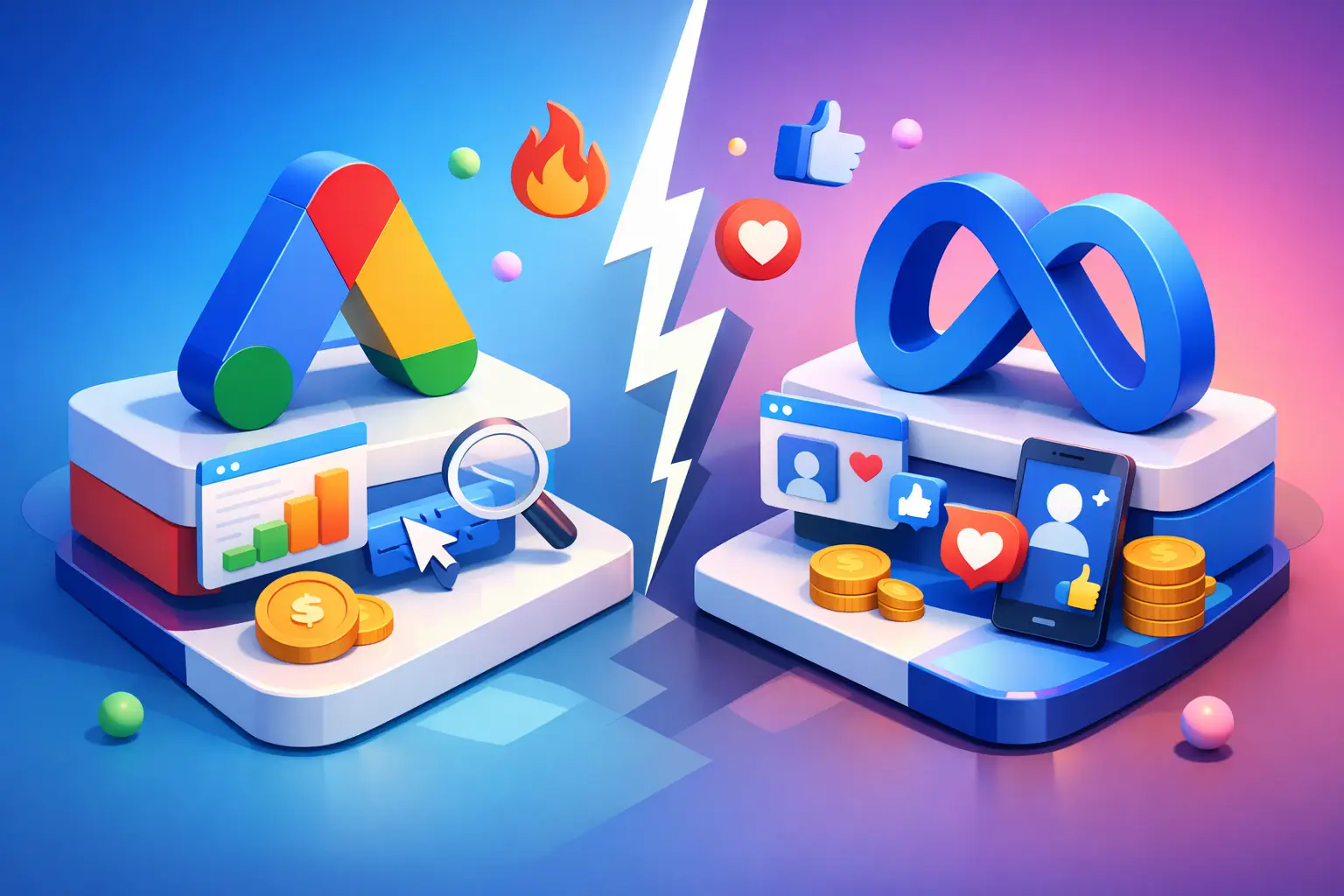
A homeowner with a leaking water heater does not open Facebook hoping to see a plumber. They search Google. But the same homeowner may scroll Instagram a week later, see a remodeling company’s before-and-after project, and start thinking about an upgrade. That difference is the heart of google ads versus meta ads.
Neither platform is automatically better. Google Ads captures demand that already exists. Meta Ads creates demand, builds familiarity, and brings people back after they have visited your site. The right choice depends on what you sell, how urgently customers need it, how long your sales cycle is, and whether your website can turn attention into action.
For most small and mid-sized businesses, the goal is not to collect cheap clicks or impressive impression counts. It is to build a customer acquisition machine that produces qualified calls, form submissions, bookings, and revenue you can measure.
Google Ads versus Meta Ads: The Core Difference
Google Ads is primarily intent-driven. A person searches “emergency dentist near me,” “roof repair Destin,” or “business attorney consultation” because they have a need right now. Your ad can place your business in front of that person at the moment they are looking for a solution.
Meta Ads includes Facebook and Instagram. It is interruption-based marketing, although good creative makes that interruption feel relevant. People are there to watch videos, follow local businesses, message friends, and browse. They are not usually searching for your service. Your ad must earn attention, explain why the offer matters, and give them a reason to act.
That distinction affects everything: targeting, creative, landing pages, lead quality, sales follow-up, and how quickly a campaign can generate results.
When Google Ads Is the Better Lead Generation Channel
Google Ads is usually the first paid channel to consider when customers actively search for what you provide. It is especially effective for urgent or high-intent services: HVAC repair, plumbers, dentists, med spas, contractors, legal and professional services, and local businesses that depend on calls and appointment requests.
The biggest advantage is timing. Someone searching “AC repair near me” is far closer to buying than someone who happens to see an AC company video in their feed. With the right keyword strategy, geographic targeting, ad copy, and landing page, Google can produce leads with a clear, immediate need.
Google also gives businesses more control over the type of demand they pursue. A roofing company can separate campaigns for roof repair, roof replacement, storm damage, and commercial roofing. A dental practice can build distinct campaigns for emergency appointments, implants, Invisalign, and new-patient exams. That structure matters because each service has different economics, search behavior, and conversion paths.
The trade-off is competition. High-value searches can be expensive, particularly in crowded markets or seasonal areas such as the Emerald Coast. Paying more per click is not necessarily a problem if the traffic becomes profitable customers. Paying for irrelevant searches, weak leads, or clicks that land on a generic homepage is the real problem.
Google Ads also requires disciplined conversion tracking. If you only measure clicks, you cannot tell whether your budget is producing calls, booked appointments, qualified estimates, or revenue. Strong campaigns track meaningful actions and use that data to improve bidding, search terms, and budget allocation.
Google Ads works best when urgency and intent are high
Choose Google as a priority when people know they need your service and are likely to search for it. It is often the clearest fit for local home services, medical and dental practices, B2B services, repair businesses, and professional firms.
It can also work well for e-commerce products with established search demand. But if shoppers do not know the product category exists, Google has less demand to capture. That is where Meta can play a much larger role.
When Meta Ads Is the Better Growth Channel
Meta Ads is powerful when visual proof, education, lifestyle, or repeated exposure helps people decide. Think real estate, fitness studios, restaurants, cosmetic services, remodeling, hospitality, entertainment, events, and products that benefit from demonstration.
A well-made Meta campaign can show a kitchen renovation transformation, a short tour of a vacation rental, a patient-friendly explanation of a cosmetic service, or a compelling customer story. Those messages can reach people who fit your likely buyer profile before they start searching.
Meta’s audience capabilities also make it useful for remarketing. Someone may click a Google Ad, browse a service page, then leave without calling. A Meta campaign can reintroduce your business with a testimonial, offer, video, or reminder. This is often where the platforms work better together than apart.
The challenge is that Meta leads can vary widely in quality. A low-cost lead form may look excellent in an ad dashboard but create a follow-up problem if prospects are casually curious, provide incomplete information, or do not answer the phone. For services with higher consideration, it can be smarter to ask a few qualifying questions or send prospects to a focused landing page rather than optimize solely for the cheapest form fill.
Creative is another major variable. On Google, a strong offer and precise keyword targeting can carry a campaign a long way. On Meta, stale creative can cause performance to decline quickly. Businesses need a regular pipeline of new images, videos, angles, offers, and proof points. The ad should look native to the feed while still making a direct commercial case.
Meta Ads works best when customers need to see the value
Use Meta as a priority if your product or service is visually compelling, if your target customer may not be searching yet, or if you need to build awareness before a sales conversation. It is also a practical way to promote seasonal offers, fill classes or events, support a new location, and stay visible to past website visitors.
For a local restaurant or entertainment business in Destin, 30A, or Panama City Beach, Meta can be particularly useful for reaching visitors and residents with timely, visual offers. The message must match the audience and the moment. A broad awareness ad is different from a last-minute booking promotion.
The Cost Question: Do Not Judge by Cost Per Lead Alone
Business owners often ask which platform is cheaper. The honest answer is that the cheaper lead is not always the better lead.
Google Ads may generate fewer leads at a higher cost, but those leads may convert faster because the prospect was actively looking. Meta may generate more leads at a lower cost, but require faster follow-up and stronger qualification to produce the same number of customers.
The metrics that matter should move down the funnel: cost per qualified lead, appointment rate, estimate rate, close rate, customer acquisition cost, and revenue or pipeline value. If your CRM cannot connect leads to outcomes, you are making budget decisions with incomplete information.
This is also why landing pages matter. Traffic from both platforms needs a clear next step, relevant proof, fast page speed, mobile-friendly forms, and a reason to contact you now. Ads cannot compensate for a confusing website, slow response times, or a sales team that does not follow up.
A Practical Way to Choose Your Starting Point
If your business has a strong existing search demand and needs leads now, start with Google Ads. Build campaigns around your highest-value services, use tightly matched landing pages, and track calls and forms that become real opportunities.
If you sell a service people discover visually or decide on over time, start testing Meta Ads with strong creative and a clear offer. Plan for lead nurture, quick contact, and ongoing creative testing rather than expecting one ad to run forever.
If budget allows, use both with distinct jobs. Google captures high-intent demand. Meta introduces your business, builds trust, and retargets visitors who did not convert. The mistake is treating them as identical channels or sending both platforms to the same generic page with no tracking beyond a contact form.
At Spry Growth, we look at the full path from click to customer: channel strategy, message, landing page, tracking, follow-up, and the revenue outcome. That is the standard worth holding any advertising effort to.
The best platform is the one that produces profitable customers after the full sales cycle, not the one with the prettiest dashboard. Start where buyer intent is strongest, measure what happens after the lead arrives, and let the numbers guide the next dollar you invest.