
August 21, 2026
Why Social Media May Not Be Your Best Marketing Strategy
Social media marketing for small businesses: build a focused strategy that turns attention into inquiries, bookings, and measurable revenue for growth.
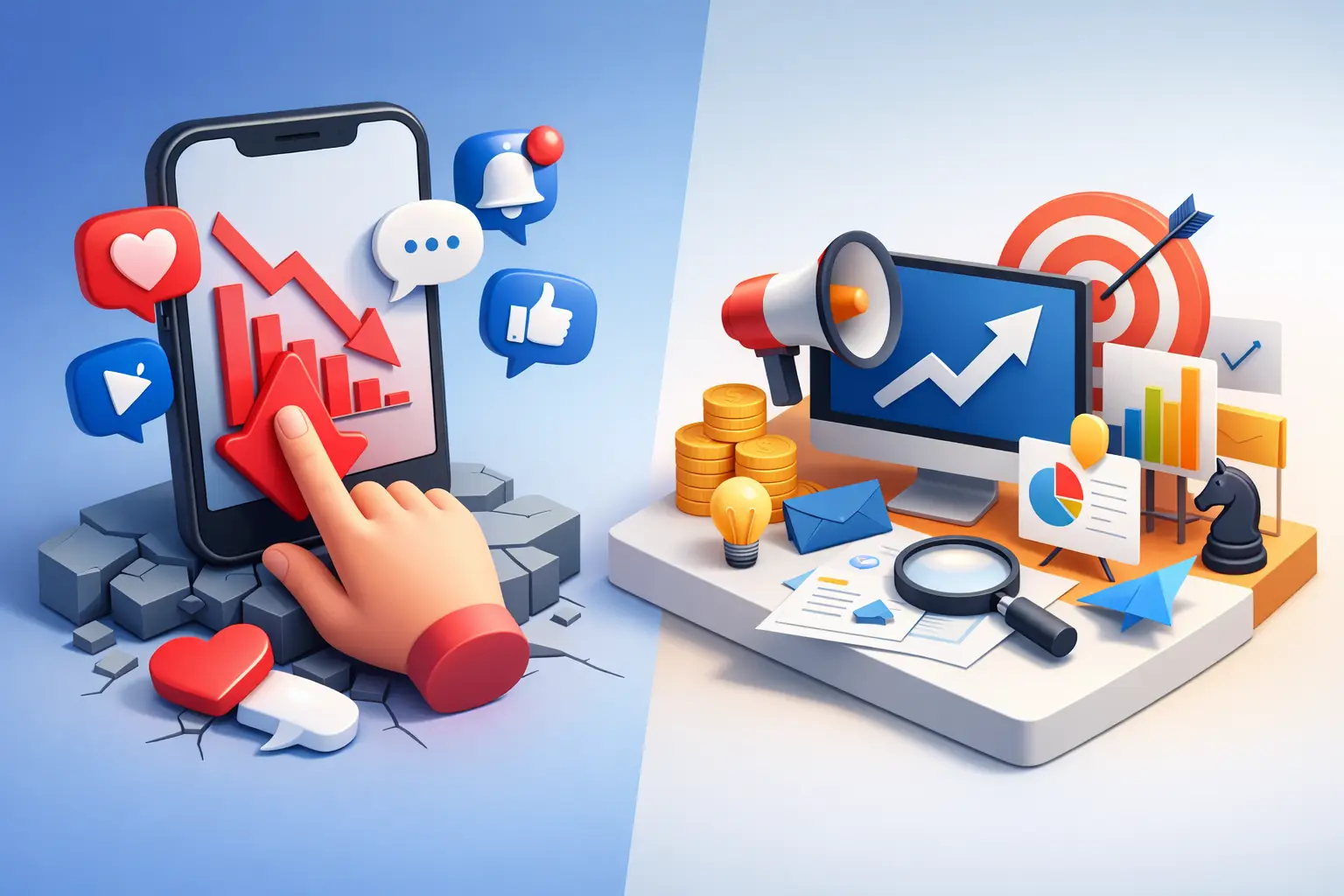
Your business probably doesn't need another Reel.
It needs more customers.
Across Destin, 30A, Miramar Beach, Fort Walton Beach, Panama City Beach, and communities throughout the Emerald Coast, local businesses are investing more time and money than ever into social media.
They're filming Reels. Making graphics. Writing captions. Posting Stories. Using AI to pump out content. Hiring social media managers to make sure something goes live four, five, or seven days a week.
And what do many businesses have to show for it?
27 likes.
A few hundred views.
Three new followers.
Maybe a Reel occasionally breaks through and gets 20,000 or 50,000 views.
That's not necessarily bad. But there's a much more important question:
Did any of it generate business?
Social media can absolutely play an important role in a company's marketing strategy. We use it ourselves, and there are businesses for which social content is incredibly valuable.
But there's a difference between using social media as part of your marketing strategy and assuming that posting on social media is your marketing strategy.
For many local businesses, that distinction could mean thousands of dollars every month.
The Social Media Content Trap
There's tremendous pressure on small businesses to constantly create content.
Open Instagram and you'll see competitors posting before-and-after photos. Scroll Facebook and another business is uploading a video. Open TikTok and suddenly the local HVAC company is participating in a trending audio.
It creates the impression that your business needs to do the same thing.
So businesses hire someone to create graphics, film videos, edit Reels, write captions, schedule posts, follow trends, and keep their accounts "active."
The problem isn't necessarily the content.
The problem is spending a significant portion of your marketing budget creating content without having a clear plan for how that attention becomes revenue.
If you're spending thousands of dollars every month on social media management, you should be able to answer a basic question:
What is this investment doing for the business?
"People are engaging with us" isn't enough.
"We're growing our followers" isn't enough.
"Our Reel got 12,000 views" isn't enough.
Those metrics can be useful indicators, but they're not the same thing as customers.
Would You Rather Have 50,000 Views or 10 New Customers?
Imagine you own a roofing company in Destin, Florida.
You create a funny Instagram Reel that takes off.
It receives 50,000 views.
Sounds fantastic.
But who watched it?
Maybe 5,000 people were in Florida. Maybe a few hundred were somewhere along the Emerald Coast. Maybe only a small percentage actually owned a home. And an even smaller percentage needed roofing work.
The algorithm's job was to find people likely to watch the video.
Your business needs people likely to buy your service.
Now compare that with someone sitting in Destin and searching Google for:
"roof repair near me"
Or:
"roofing company Destin FL"
That person may never have seen your latest Reel.
They may not follow your business.
They might not care whether your Instagram account has 800 followers or 8,000.
But they have something considerably more valuable:
Intent.
They have a problem, they're actively searching for a solution, and your business has an opportunity to appear at the exact moment they're looking.
That's the difference between attention and intent.
And businesses shouldn't confuse the two.
Attention Is Not the Same as Intent
Marketing is ultimately about reaching the right person, with the right message, at the right time.
Organic social media gives businesses relatively little control over that equation.
You can create excellent content, but the platform ultimately decides who sees it.
That can work incredibly well when the algorithm finds the right audience.
But what happens when it doesn't?
Consider a business serving customers exclusively around 30A, Santa Rosa Beach, or Miramar Beach.
A Reel receiving thousands of views from Atlanta, Nashville, Dallas, and Los Angeles might make the analytics report look impressive.
But if those people aren't potential customers, what is that exposure actually worth?
This becomes especially important for local service businesses.
A dentist in Fort Walton Beach doesn't need to be famous on TikTok.
A contractor in Panama City Beach doesn't necessarily need 100,000 Instagram followers.
A professional service company in Destin doesn't need every post to go viral.
They need to consistently get in front of the people most likely to become customers.
The Hidden Cost of "Organic" Social Media
Organic social media is often described as free marketing.
It's not.
Posting on Instagram may be free.
Producing everything required to consistently post isn't.
Businesses may pay for:
- Social media management
- Photography and videography
- Reel production
- Graphic design
- Copywriting
- AI content tools
- Editing
- Scheduling software
- Strategy
- Employee time
A local business could easily spend $1,500, $2,500, $3,000 or more each month maintaining an aggressive organic social presence.
That might be a fantastic investment if it's contributing to business growth.
But it creates an important opportunity-cost question.
If your business has $3,000 available for marketing this month, should most of it go toward producing organic content?
Or could some of that budget be better spent deliberately putting your business in front of potential customers?
There isn't one answer for every business.
That's exactly the point.
What Targeted Advertising Does Differently
Paid advertising doesn't automatically make marketing successful.
Bad targeting, bad creative, weak offers, poor landing pages, and improper conversion tracking can burn through an advertising budget surprisingly quickly.
But advertising gives businesses something organic social media often can't:
Control over distribution.
Instead of creating something and hoping the right person sees it, you can intentionally build campaigns around specific audiences, locations, behaviors, searches, and stages of the buying process.
Different platforms accomplish that in different ways.
Google Ads: Capture Existing Demand
Google Ads can be incredibly powerful because you're often reaching someone who is already looking for a solution.
Someone searching:
"dentist near me"
"AC repair Destin"
"web design 30A"
"personal injury attorney Fort Walton Beach"
or
"marketing agency Panama City Beach"
is telling Google exactly what they want.
A properly structured Google Ads campaign can position a business in front of those people at the moment they're searching.
You're not trying to convince someone to care about air conditioning repair while they're watching vacation videos.
You're reaching them when their AC isn't working.
That's a fundamentally different type of attention.
Meta Ads: Create and Capture Demand
Facebook and Instagram advertising can solve a different problem.
Someone may not be actively searching for your service today, but they may still fit the profile of your ideal customer.
Meta allows businesses to distribute offers and creative beyond the people who already follow their accounts.
That means the content you're creating doesn't necessarily have to sit on your Instagram page waiting for the algorithm to decide what happens.
You can put advertising dollars behind it.
You can test different messages.
You can promote specific offers.
You can retarget website visitors.
You can stay visible to people who have already interacted with your business.
And for local companies, campaigns can be structured around the geographic markets the business actually serves.
LinkedIn Ads: Reach Business Decision-Makers
For B2B businesses, LinkedIn can provide another advantage.
A company selling commercial services may care less about reaching thousands of random consumers and more about reaching business owners, executives, managers, or professionals within certain industries.
That's a completely different marketing challenge.
Organic thought leadership can be extremely valuable on LinkedIn, but paid targeting can supplement that strategy by deliberately reaching people who fit the company's target customer profile.
TikTok Ads: Turn Creative Into Targeted Distribution
TikTok can be incredibly powerful for the right company.
But again, the question shouldn't simply be:
"Should our business be on TikTok?"
It should be:
"Are our customers on TikTok, and can this platform profitably help us reach them?"
If the answer is yes, great.
If the answer is no, being active there simply because TikTok is popular doesn't make it a good marketing investment.
Does This Mean Your Business Should Stop Posting on Social Media?
No.
That's not the argument.
Organic social media can provide tremendous value.
Imagine someone searches for a service on Google, clicks an ad, visits the company's website, and then looks them up on Instagram.
What do they see?
Recent projects.
Customer testimonials.
Behind-the-scenes content.
Employees.
Helpful information.
Professional photography.
An active business that clearly exists and does good work.
Social media just contributed to the sale — even if Instagram wasn't where the lead originated.
That's why organic social media can be incredibly useful for credibility, trust, social proof, brand personality, and staying top-of-mind.
For certain industries, organic social can also be a major acquisition channel on its own.
Restaurants, tourism companies, fitness brands, entertainment businesses, real estate professionals, hospitality companies, retailers, and visually driven brands can have enormous opportunities on social media.
Here along the Emerald Coast, that's especially relevant.
A restaurant on 30A, a fishing charter in Destin, a vacation experience in Panama City Beach, or an entertainment business targeting tourists may have much more to gain from visual social content than a company selling a highly specialized B2B service.
The marketing strategy should fit the business.
Not the trend.
Stop Measuring Marketing in Likes
One of the most dangerous things about digital marketing is that nearly everything produces a number.
Followers.
Views.
Reach.
Impressions.
Likes.
Comments.
Clicks.
Because those numbers are easy to see, they're easy to mistake for success.
But the metrics closest to revenue matter more.
How many phone calls did marketing generate?
How many forms were submitted?
How many appointments were booked?
How many estimates were requested?
How many qualified opportunities entered the pipeline?
How many became customers?
How much revenue did those customers generate?
Those questions aren't as exciting as saying a Reel received 100,000 views.
But they're considerably more important to the business owner paying the marketing bill.
Your Website Matters More Than You Think
There's another piece businesses often overlook.
Getting someone's attention is only the beginning.
If a Google Ad, Facebook Ad, Instagram post, LinkedIn article, or organic search result sends someone to a slow, confusing, outdated website, the marketing system can still fail.
Your website needs to turn attention into action.
That means clear messaging, strong service pages, easy calls to action, mobile optimization, local relevance, conversion tracking, and landing pages that match the campaign sending people there.
For businesses throughout Destin, Miramar Beach, 30A, Santa Rosa Beach, Fort Walton Beach, Niceville, and Panama City Beach, local SEO should also work alongside paid advertising.
Someone searching for a service today may click an ad.
Someone else may find your business organically next month.
Another person may discover you on Instagram, visit your website, leave, and return through Google three weeks later.
Real customer journeys aren't always linear.
That's why marketing works best as a system, not a collection of disconnected activities.
Social Media Should Support Your Marketing Strategy — Not Be Your Entire Marketing Strategy
Your business doesn't necessarily need to stop posting.
It may simply need to stop posting without a purpose.
Instead of asking:
"How many Reels should we post this month?"
Start with:
"How do our best customers actually find businesses like ours?"
Then build your strategy around the answer.
Maybe that's Google Ads.
Maybe it's Meta Ads.
Maybe it's SEO.
Maybe it's LinkedIn.
Maybe it's email marketing.
Maybe organic social media really is one of your strongest acquisition channels.
Most likely, it's some combination of several channels working together.
The objective isn't to be everywhere.
It's to be in the right places.
Build Your Marketing Around Customers, Not Vanity Metrics
At Spry Growth, we don't believe every business needs the same marketing strategy.
A contractor in Fort Walton Beach has different customers than a restaurant on 30A. A professional services firm targeting businesses nationwide has different needs than a tourism company in Destin. A growing company in Panama City Beach may need a completely different combination of advertising, SEO, content, and website strategy.
The question isn't whether Google, Instagram, Facebook, LinkedIn, TikTok, or any other platform is "best."
The question is:
Which channels give your business the best opportunity to turn marketing dollars into actual customers?
That's what your marketing strategy should be built around.
If you're spending thousands every month on marketing but can't clearly connect that investment to leads, appointments, sales, or revenue, it may be time to rethink where your budget is going.
Your business doesn't need more marketing activity just for the sake of being active.
It needs marketing that moves the business forward.